Paperbacks from Hell: The Twisted History of ’70s and ’80s Horror Fiction – Grady Hendrix
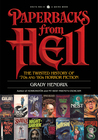
Paperbacks from Hell: The Twisted History of '70s and '80s Horror FictionPaperbacks from Hell: The Twisted History of ’70s and ’80s Horror Fiction by Grady Hendrix

My rating: 4 of 5 stars

I saw Grady Hendrix on a convention panel, was immediately captivated by the thought of all the things I didn’t know about horror fiction, and then entered (and won) a giveaway for this book. It took me a year and a half to read it, picking it up and putting it down as my desire to study the subject waxed and waned. It’s a lot to take in all at once, but it makes for a great bed- or couch-side read.

The text is tightly-written, witty and smart, devoting time to the subgenres of horror as they rise and fall, the books themselves and their writers, the cover artists so rarely named or lauded for their work, strung along a thread of the boom and bust of the publishing houses putting all these books into the hands of the masses. That anecdotal balancing act kept the book from feeling repetitive (“oh, and then this novel, and then this one, and this one . . .”). It delivered what was promised: a history of the books, their stories, cultural context, and the business and people behind and around them.

You may walk away from this book with a reading list to keep you busy for years. You may, like me, enjoy knowing more about that period of horror fiction and its echoes down the years than feel any great desire to read the greatest hits of decades past. I didn’t get really excited and start looking up authors and books until I got to the last section, about the psychological and genre-crossing horror of the early nineties under Dell’s short-lived Abyss imprint, edited by Jeanne Cavelos. If nothing else about this book appeals to you, it makes a great coffee table book for the wealth of full-color cover images, ranging from stark and iconic to bizarre and lurid.

I recommend this to anyone discovering (or re-discovering) an interest in horror fiction who isn’t quite sure what parts of the horror spectrum appeal to them. This book is also wonderful for anyone who enjoys knowing the history of genres and publishing, or just wants to read clever and sarcastic essay-reviews about older books.

View all my reviews

Steeplejack – AJ Hartley

Steeplejack (Steeplejack #1)Steeplejack by A.J. Hartley

My rating: 1 of 5 stars

Well that was underwhelming.

Fantasy thrillers are my jam, but Steeplejack is a disappointment. The worldbuilding relies too heavily on a mish-mash of Victorian and generic colonialist tropes, an unsatisfying shorthand to create a society that feels more like a backdrop for a plot than a real place an intriguing story is happening. Ang is a cardboard cut-out of a Real Girl, her investigation awkwardly interrupted by confusing and inexplicable sexual and romantic attractions to any young man she has a serious conversation with as well as her struggle against a generic patriarchy that feels as empty and pointless to the world and the story as it does to the characters who wish it wasn’t there. I wish it wasn’t there. I want more interesting obstacles for a character in a story like this, not the old stand-by.

The luxorite and the disappearance of the Beacon are a solid foundation for an urban fantasy detective thriller. If this had been a tight and fast novelette or novella—drop the unnecessary patriarchy and the appallingly unrealistic b-plot where Ang takes care of a baby for several days without ever changing its diaper while fighting with a sister that does little for the story that can’t be accomplished through other characters—and it would have packed the punch the author wanted. The only reason the narrative felt fast-paced was because I sped-read my way through, skipping anything that wasn’t dialogue or necessary plot information; everything else was filler.

View all my reviews

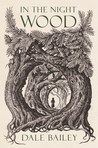
In the Night Wood – Dale Bailey

In the Night WoodIn the Night Wood by Dale Bailey

My rating: 5 of 5 stars

This book does everything I want a haunting story to do: echoes and parallels; allusions and mash-ups of ancient sinister figures; the blurring of lines between grief and madness; the uncovering of old family secrets; history recent and ancient repeating itself again and again; shadows and dread and a legacy of darkness.

This is one of the few stories meditating on stories I’ve enjoyed in quite a while, because it focuses on the stories and not the storyteller or the act of telling the story. This focus keeps the story from becoming another self-indulgent meditation on the act of writing, keeps it in the realm of horror as the character realizes he’s just another turn on an inexorable wheel. Such an effective use of the ouroboros motif.

I’ve been equally fascinated and unsettled by the horned king/erl-king/Cernunnos/Herne since I first read about them years ago. Bailey crafts a wonderfully sublime threat from what little we know of these mythic figures.

I didn’t want this book to end, I enjoyed reading it so much.

View all my reviews

Mapping the Interior – Stephen Graham Jones

Mapping the InteriorMapping the Interior by Stephen Graham Jones

My rating: 4 of 5 stars

So much packed into such a small, unsettling space. Jones walks the line so many attempt in stories like this, the ambiguity of is-it-real or is-it-all-in-their-mind. Junior’s child logic keeps us wondering through nail-biting confrontations with the thing that might be the ghost of his father, or might be his own mind’s efforts to impose meaning and logic on meaningless and illogical things. The gritty reality of the story is so grounding, you don’t even realize its true horror until the end, where you see what lies within Junior, that neither Junior nor Dino ever really grow up or truly leave that house, never escape the legacies that made them. The layering of meaning and metaphor in this novella is masterful.

View all my reviews