Pacific Fire (Daniel Blackland #2) – Greg Van Eekhout

Pacific Fire (Daniel Blackland, #2)Pacific Fire by Greg Van Eekhout

My rating: 3 of 5 stars

Like many follow-ups to tightly-focused first novels, Pacific Fire expands the story started in California Bones into a larger landscape and a larger problem. To avoid telling the same story again, escalation is necessary. Unlike many sequels in the bigger-and-better tradition, Pacific Fire doesn’t get too large and unwieldy. It keeps an intimate focus on a small number of characters, and keeps the scope of the plot reigned in on the objective.

Sam is a great character, his arc very different from Daniel’s, and I enjoyed following his story. However, I didn’t enjoy this book as much as the first. Sabotage stories are good, but heist stories are better. California Bones is suffused with a kind of wicked joy, where everyone in Pacific Fire is weighed down by guilt and the feeling that time is too short.

I’m intrigued to see how book three’s con job stands out in the line-up.

View all my reviews

A Local Habitation (October Daye #2) – Seanan McGuire

A Local Habitation (October Daye, #2)A Local Habitation by Seanan McGuire

My rating: 3 of 5 stars

“ . . . and gives to airy nothing / A local habitation and a name.”

I love the epigraph, and the way the theme carries through the characters in this novel: the employees of ALH trying to form a community, Quentin trying to establish himself as a foster in a House that’s not his own, Toby still feeling the absence of her own comfortable habitation, lost and yet to be re-established; and also how bad ideas and problems and illness can take up residency in a person or a community and sow ruin.

There is a lot more to love about this book, and I will make a list for you before I start talking about the things that didn’t work for me. Awesome things in A Local Habitation: humor, discussions about consent, Toby and Quentin as buddy cops (more please!), loads of faerie, and Tybalt.

I enjoy mystery stories, but locked room mysteries are hard, because the reader either knows they’ve already met the killer or is expecting that trope to be subverted in an interesting way. While McGuire plays her hand well by keeping us guessing about the extent of April’s involvement (which also serves as a distraction from identifying the culprit), in the end I wanted the subversion, not the killer I’d already met. I wanted the big surprise, and I didn’t get it. While locked-room mysteries are often lauded for how they master the genre under the constraints of a closed system, the closed system is often what I like least about them. I like stories that move around. McGuire does a lot with the form, and subverts it by having a huge “locked room” for the characters to move around in, but in the end, they ran in circles and the futility of it became oppressive.

A Local Habitation is the second book of the series, but feels like the middle, with familiar characters even though so many of them were new. Reading it felt like a new season of a favorite show. On the other hand, the book was less satisfying than Rosemary and Rue. When I finished this book and put it down, I did not remember positive things. I remember Toby’s constant state of pain and injury and hopelessness. The shadow of loss and grief hangs heavy over this book. If it is a new season of a show, it is the season where everyone goes through the wringer and triumphs feel small. I can only hope things look a little brighter as I read further into the series. I’ve given up on shows that became joyless slogs, but I’m not giving up on Toby Daye just yet.

View all my reviews

The Haunting of Victorian Houses

The Imaginary Bookshop drew my attention to this Scientific American article about how the Victorian house became so haunted.

I love haunted house stories and Victorian architecture. I also live in a Victorian house in Salem, MA. Before you get excited imaging the big gabled and turreted Painted Ladies lining the Salem Common or looming over the residential section of Essex Street, I must disappoint you and myself by clarifying that I live in what I call a workaday Victorian. No turreted windows or gables, although we do have a few bits of fancy trimming. It is a small house built in the 1880s as two apartments for a professional woman and her mother, with an attic apartment added later. My favorite part of my apartment is the pocket doors separating the living room and dinning room, and the original Art Nouveau trim around the windows and doors.

My least favorite part about my apartment is that parts of the house crumble around us if we’re not careful: the walls old horsehair plaster, the basement a flaking rubble-stone foundation, one front porch railing spindle rotting away. I don’t own the property, so I can’t invest in replacing or restoring any of these problems. I couldn’t even afford the purchase this creaky old place if it were on the market.

I was struck by these lines in the article, regarding the shift in America’s societal attitude toward Victorian homes in the 1930s and 40s:

It’s during this time that the very experience of the home came under fire for representing outdated customs. For example, prior to rise of funeral homes, it was customary for the dead to be received at home, meaning it was a Victorian custom for the deceased to be laid out in the parlour of the home for viewing. For a society looking forward, this was another perversion that these home harbored. This feeling of wrongness was able to grow exactly because so many people of the time had experienced these things themselves: they had seen home funerals, they had watched the factories belch soot in their towns, seen the spread of poverty that served to support the economic advancement of a few.

The article goes on to mention the chopping up of Victorian houses into apartments and “rooming houses, which carried their own horrific experiences.” Many of the grand old houses around Salem are divided into smaller units, rented for increasingly outrageous prices to people like me, who work in Boston but can’t afford to live in the city or buy a house in its very steep market. Even if I could afford the cost of buying one, the horrors of knob-and-tube wiring, rot, and badly-done past renovations give me pause. My husband and I make good money, but the longer we live here, the more I feel that I teeter on the edge of the poverty I see across the country. Everything I make is sucked into rent and student loan payments. A costly renovation to draw one of these houses into the current century is even further beyond our means than saving a down payment. It’s a common story in today’s America, nearly a century after society first turned on the Victorian, and it remains the same: the few advance economically on the backs of the rest of us, trapped in moldering Victorian shrouds.

If I wanted to return to my home town in the Midwest, I could purchase a Victorian mansion in the city’s historic district for less than I owe on my student loans. But my home town, like its grand old houses of a bygone era, has been left to decay. While I may offend those who happily live their lives there by saying so, I can’t escape the feeling every time I visit. Sad strip malls and an aggressively-judgemental small-town attitude make a mid-sized city feel claustrophobic and provincial to my East-coast city-living tastes. Even those living grandly in the historic district, slowly restored one house at a time, exist side-by-side with the residents of the houses that were converted to smaller and smaller apartments in the decades of the neighborhood’s decline. One neighborhood, layers of social strata: the wealthy, the comfortable, and the poor. And I wonder every day, how many are truly comfortable? Do they feel the precipice at their toes, as I do?

Poverty haunts America, and has since the founding of the country. For some, poverty is a terrifying malevolent specter, waiting to jump out and ruin their lives, looming like the turrets of the Victorian mansions, the status symbols of their wealthy predecessors left to rot. They hoard their wealth, hide their money, push through economic policies crafted to safeguard and increase their wealth with no regard for the rest of us. For others, poverty is a workaday companion, Grandad’s ghost who twitches the curtains of their workaday lives in their workaday homes, mostly ignored because who has the time to be worried about that when the bills must be paid? My workaday Victorian home stands on a quiet side street amongst other plain facades of the era, evoking the Colonial coastal-town aesthetic more than an Amityville horror vibe. Nonetheless, my upstairs neighbor informed me when I moved in that we have a vagrant ghost in the basement, a transient-spirit who moves from house to house on the street, staying only a day or two at a time. I’ve never encountered the vagrant, but I also have no time for that. I would rather write fiction and see economic equality for the living in my lifetime than tangle with the restless dead, be it an inhabiting spirit or the house itself.

Rosemary and Rue (October Daye #1) – Seanan McGuire

Rosemary and Rue (October Daye, #1)Rosemary and Rue by Seanan McGuire

My rating: 4 of 5 stars

Very refreshing to read an investigator-in-the-aftermath-of-persona-trauma story that doesn’t rely on the classic tropes of alcoholism, a failed relationship due to emotional constipation, tragically-dead spouse/child(ren)/whole family, or accidentally-killed-someone-on-the-job as the cause or outcome of that trauma. Toby experiences long-term captivity and loss-of-self that skews her self-perception and how she relates to others, and we watch her work through the early stages of her recovery surrounded by supportive people trying to help, while she races to solve a friend’s murder before her time runs out. McGuire also takes on the second-coming-of-age/you can(‘t) go home again trope with an actual place called Home and a serious exploration of what it means for an adult to grapple with who they used to be, what they’ve learned since their adolescence, and how much of that version of their self they have or haven’t left behind. All of this AND a kick-ass take on faerie makes for one hell of an urban fantasy murder-mystery thriller. I can’t wait to read the rest of this series!

View all my reviews

So Many Books! (World Fantasy Convention 2018 and my TBR bookcase)

I sort of finished that shawl before I went to Baltimore for World Fantasy Convention 2018. I haven’t added the tassels (and I’m not sure I will), and I still haven’t blocked it for proper stretch and drape. I took it with me anyway and wore it more like a scarf than a shawl. Worth it. I’ll block it eventually. It would be easier if I had a guest bed to lay it on while it dries, but I’ll have to make do with my kitchen table or the floor.

My convention experience was atypical this year. I usually attend a panel nearly every hour, stalk the book swap table, and circle the dealer room more times than necessary, buying books I’ve never heard of but might be my next favorite. I don’t socialize easily, and get nervous about talking to people I don’t know. This year, I had friends at the convention who introduced me to more cool people, so I had actual conversations with strangers. I got to introduce myself as a published writer, and that made me feel more comfortable talking about writing and asking my new acquaintances what they like to write and read. I hardly attended any panels at all, and I ate out for most of my meals because the Baltimore food scene is killer (if you find yourself in Baltimore, I recommend Miss Shirley’s and Ida B’s for some delicious soul food!). And I challenged myself to only buy books I already wanted to read, leaving the book bag for surprises.

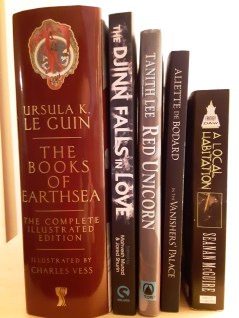
The photo on the left is the books I started with in my bag, and the photo on the right is the books I ended with after relentlessly stalking the swap table (some things never change, and the swap table is one of my favorite parts of the con).

And here’s the books I purchased:

WFC2018_books purchased

Only five! (Considering I regularly purchase anywhere from 12 to 20, this is very restrained for me.)

My next challenge is to read as many of these books as possible before Readercon in July, where I will inevitably purchase more. I only came home with eight books from this past Readercon, and intended to read them all before Baltimore, but alas, I only got through half.

On the bookshelf in my living room, three of the five shelves are filled with my TBR pile. They were starting to go two deep, and I was starting to feel anxious every time I looked at the shelf, which is often, because you can see it from everywhere in my small living room. Over a decade of accumulating books at convention- and second-hand-store buying binges, plus free books from past World Fantasy Cons that I still think look interesting but never quite get to, has left me with a lot of books I was very excited about when I acquired, but have since experienced a waning interest in. Last year I purged my collection of books I finally admitted to myself I was never going to read. But I still had quite a lot that I just didn’t want to give up on. When I found myself paralyzed by guilt and indecision about what to read, I made a choice to pull out books I don’t particularly want to read right now or in the near future, but don’t want to get rid of because I still feel that I will want them someday. I put those books in a box, and I don’t feel bad about it. All my TBR books fit on the shelf now, and my goal is not to clear the shelf, but to keep it so everything fits.

This Thanksgiving weekend is Readsgiving. Books and pie! I am very excited about what’s on my shelf.