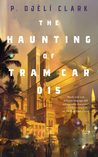
The Haunting of Tram Car 015 – P. Djèlí Clark

The Haunting of Tram Car 015The Haunting of Tram Car 015 by P. Djèlí Clark

My rating: 4 of 5 stars

I enjoyed this SO MUCH.

Not only is it delightful to return to the world of “A Dead Djinn in Cairo,” Clark develops the world further while he tells another story. The conversations underpinning the world about modernity, social change, gender roles, and feminism, carry forward into The Haunting of Tram Car 015 and not only advance in the background but are intrinsic to the plot. The style and technology move from Victorian Steampunk into Art Deco. I could visualize the many geometric patterns and the Art Deco style of the women’s suffrage posers while reading this story, and although it doesn’t quite go full Decopunk, the flirtation in that direction makes my heart happy. Clark turns the second wave of Egyptian Revival from the Art Deco period an actual Egyptian movement instead of a Western fashion trend. The alternate history worldbuilding is so tight and clever, I can’t say enough good about it.

As I’ve come to expect from Clark, he delivers a kick-ass story driven by kick-ass characters. Every encounter is a character study, and every character leaps off the page. Hamed and Fatma gossiping about her case from “A Dead Djinn in Cairo” over tea and cake was the perfect ending note.

More, please.

View all my reviews

The Bitterwood Bible and Other Recountings – Angela Slatter

The Bitterwood Bible and Other RecountingsThe Bitterwood Bible and Other Recountings by Angela Slatter

My rating: 5 of 5 stars

I love related short stories, and Angela Slatter takes it to the next level in The Bitterwood Bible and Other Recountings. She explores the history of an order of archivist nuns, their fight against a man seeking immortality, and the strange and tragic tales of the many women whose lives and family histories cross and re-cross paths with this conflict. Each story stands on its own, with perhaps the exception of the final story, “Spells for Coming Forth by Daylight,” which follows immediately on the heels of “By the Weeping Gate” and must tie up all the threads of this epic tale.

This collection absolutely deserved its win of the 2015 World Fantasy Award. I feel like I read a multi-book series in 270 pages. I didn’t want it to end, so I doled out the stories slowly, and when I read the last line of the last story, I desperately wanted to return to the beginning and read it all again. I enjoyed Slatter’s collection of fairy-tale retellings, The Girl with No Hands, but the stories of The Bitterwood Bible make me want to write. They are that satisfying and inspiring.

View all my reviews

Deep Roots (The Innsmouth Legacy, #2) – Ruthanna Emrys

Deep Roots (The Innsmouth Legacy, #2)Deep Roots by Ruthanna Emrys

My rating: 2 of 5 stars

I enjoyed Winter Tide, and I looked forward to Deep Roots, looked forward to again following a quiet, contemplative protagonist as she searched for survivors of her people to rebuild her community. As much as I love thrillers and adventure stories, I also like taking a break with a character who is cerebral and relationship-focused, a thinker like me.

Winter Tide’s search for information in the midst of paranoia and mistrust was like reading a John Le Carre spy novel, slow but satisfying. Unfortunately, Deep Roots didn’t satisfy me in the same way. Emrys tried to use the same techniques again, but that, ultimately, was the problem. That ground had been trod. Deep Roots needed to be a different kind of story. It had all the elements of a more old-school pulp sci-fi action story (aliens, G-men, everyday folks caught in the middle!), but it didn’t come together that way. I wanted this book to be a blend of an action-thriller and a cerebral exploration, but it was too much thinking and not enough action.

I usually advocate for larger casts of characters in stories, but a large cast requires splitting it into smaller groups, and too many of the characters in Deep Roots are together too much of the time. I could see the work Emrys was putting in when seven or eight people were crammed in a hotel room or a van trying to have a conversation. All they did was bicker, and it was work to read it and keep everyone distinct. The first-person narrator is also too much of a constraint on the novel’s structure. We only get other points-of-view through brief, italicized journal entries. Emrys allows the conceit of the diary entry to fall away as she writes these scenes, and I wanted her to take it further and allow the first-person narrative to be disrupted by third-person chapters that follow these other characters. I was excited to follow Caleb and Deedee into their own investigation, and instead that fizzled out. Switching between first- and third-person narration is a workable model, and in this story would have allowed us to follow other characters and know things Aphra doesn’t. It would have made the story feel less claustrophobic.

These characters also talk everything to death. They keep talking about paranoia, but it feels like anxiety as the talk their way in circles about the Outer One’s motivations and philosophies and the rights of everyone to do what they want, but what about The Consequences. I didn’t care about the consequences anyone would suffer in this book. I didn’t care if they convinced Freddy to move to Innsmouth to help them reclaim and rescue the land. I didn’t care if Nekko went traveling with the Outer Ones. I knew Aphra wouldn’t suffer any permanent damage from the Outer One’s technology because she’s the protagonist and she’s suffered enough, and I knew Emrys wasn’t going to permanently disable her any more. The only exciting rescue of consequence in the story was when they went to save Spector. I just wanted them all to take more action instead of analyzing everything into a state of stupor. A car chase, fist-fight, or on-page kidnapping would have added some zing. Aphra kept thinking, “we’re running out of time,” but I felt no sense of urgency from eighty percent of the text.

Aphra spends almost the entire book in a state of exhaustion, wringing her mental or physical hands about what’s happening around her and the mistakes she’s making. I was exhausted reading this book. I almost abandoned it several times, and I skimmed the last hundred pages, pushing myself to finish because I’m a completionist and got really stubborn about it. But I didn’t enjoy it, and that makes me sad because I genuinely wanted to.

View all my reviews
“A Dead Djinn in Cairo” – P. Djèlí Clark

A Dead Djinn in CairoA Dead Djinn in Cairo by P. Djèlí Clark

My rating: 5 of 5 stars

I re-read “A Dead Djinn in Cairo” both to prepare for reading Clark’s new novella set in the same world, The Haunting of Tram Car 015, and because I heard Clark speak about “A Dead Djinn in Cairo” during a panel appearance at Readercon in 2018, and I realized how much I had missed, and how little credit my previous review gave the depth of the story.

After I first read this, I was caught up in the wonderfully quick pace, the witty banter of the characters, the satisfaction of the climactic fight scene, and I called this story a confection. I often compare writing to desserts, because I love both, but that review does “A Dead Djinn in Cairo” a disservice.

This novelette has more markers and symbols of colonization and the anxiety of modernity than a James Joyce story. Lush with details that are so excellently woven into the fabric of the narrative, I didn’t notice them until Clark said the story is about colonization, and I read it again. Egypt has a very long history as colonizer and colonized, which Clark pays careful attention to throughout. In this alternate history, not only is technology developed at an earlier time to give it steampunk elements, the Egyptians stave off British colonialism and impose their own colonization on neighboring Sudan. And in turn, they are all colonized by creatures of legend emerging again into the world—djinn, angels, ghuls, gods, and monsters. None of the political colonizing is described in the text—I learned of the fight between Egypt and Britain to colonize Sudan when I started looking up the history of colonialism in Egypt—and yet it is, through every minutiae of cosmopolitan Cairo in the early 20th century, and the characters we meet as they move through their re-imagined cityscape investigating the mysterious death of the titular djinn.

I recently read Clark’s novella The Black God’s Drums, which does for New Orleans what he does here for Cairo—sketch out a whole different history in a few words, a few pages; food, clothes, and the people consuming them; city streets and the people inhabiting the corners. I immediately slide into his reimagined places as though they have always been this way. I won’t overlook the complexity again.

View all my reviews

The Black God’s Drums – P. Djeli Clark

The Black God's DrumsThe Black God’s Drums by P. Djèlí Clark

My rating: 4 of 5 stars

I am loving the explosion of speculative fiction set in New Orleans. The Black God’s Drums isn’t just speculative fiction, it’s alternate history. And on top of that, it’s steampunk. Just take all my money now.

Like Sarah Gailey in American Hippo, P. Djeli Clark takes us down the Mississippi river to the Big Easy by way of a few changes to your history textbook. Successful slave rebellions, a few alterations to the American Civil War, a dash of steampunk, and you’ve got the free city of New Orleans, an airship port straddling the tenuous relationship between the North, the South, and various island nations of the Caribbean. Clarke deftly walks us through this within the 110 pages of the novella, scattering well-placed details when they become relevant to the story instead of info-dumping all the ways this New Orleans is not the city you know at the beginning of the story. He trusts the reader to pick up what he’s putting down, and I like being treated as a smart reader.

Creeper and Ann-Marie are the best sort of mirrored characters—each carries a god, but they deal with it in opposite ways. Both are forced to reckon with these strange inhabitations in the climax of the story, which Clark wastes no time getting to. Some novellas feel like incomplete novels, but this one is exactly the right length—for the story, anyway. I would happily spend a lot more time in this version of the world. (Can we please have more stories with the nuns? They completely steal the one scene they’re in, and from that one scene, we can extrapolate half a dozen elevator pitches for other stories set in this world.) The power team of Ann-Marie and Creeper can come, too.

View all my reviews